
K&F Concept Review: Quality, Pricing & Performance
Insurance Finance Affiliate Marketing Branding Business Digital Marketing Market Trends Technology K&F Concept Review: Quality, Pricing & Performance If you’ve
Perimeter 82 Review 2026: Features, Benefits, and Security Insights
Discover our in-depth Perimeter 82 review for 2026, covering its key features, Zero Trust security model, SASE capabilities, pricing, benefits, and real-world performance insights. Learn how Perimeter 82 helps businesses secure remote access, protect hybrid workforces, and modernize enterprise cybersecurity.
Traditional VPNs were once considered the gold standard for remote connectivity. Years ago, businesses mainly operated through centralized office networks, and VPNs allowed employees to securely access internal systems from outside locations. That model worked well when remote work was rare and cyber threats were less sophisticated. Fast forward to 2026, and the situation looks completely different. Employees are constantly moving between devices and networks, while attackers use advanced phishing campaigns and credential-stealing malware to infiltrate corporate systems.
The biggest flaw of traditional VPNs is that they often provide overly broad access once a user is authenticated. Imagine a hotel giving guests access to every room in the building just because they checked in successfully. If a hacker steals a single set of credentials, they may gain unrestricted access to critical business systems. This creates massive security exposure, especially for organizations handling sensitive customer data or financial information.
Cybersecurity threats have evolved dramatically over the last decade. Businesses are no longer only worried about external attackers breaking through firewalls. Insider threats, compromised credentials, ransomware campaigns, and phishing attacks have become some of the biggest risks facing organizations today. In many cases, attackers don’t even need advanced hacking skills. They simply trick employees into revealing passwords or exploit poorly secured devices connected to corporate networks.
Zero Trust security addresses this problem by removing the assumption that any user or device should automatically be trusted. Every access request is evaluated based on multiple factors such as user identity, location, device health, authentication status, and risk level. This layered approach creates a much stronger security posture compared to traditional perimeter-based defenses.
One of the defining features of Perimeter 82 is its Zero Trust Network Access (ZTNA) architecture. Unlike traditional VPN solutions that grant broad network access after login, ZTNA operates on the principle of least privilege. This means users only receive access to the exact applications and resources necessary for their work responsibilities. It’s similar to giving employees access badges for specific office rooms instead of handing out master keys.
The ZTNA framework continuously verifies every connection request in real time. Even after users authenticate successfully, the system still checks device security posture, geographic location, network conditions, and behavioral patterns. This dynamic verification process significantly reduces the likelihood of unauthorized access caused by stolen credentials or compromised devices.
Perimeter 82 strongly embraces the Secure Access Service Edge (SASE) framework, which combines networking and security services into a cloud-delivered architecture. In simple terms, SASE removes the dependency on bulky hardware appliances and shifts security management into the cloud. This approach allows businesses to scale rapidly without constantly upgrading physical infrastructure.
One major advantage of SASE is improved performance for remote teams. Instead of routing all traffic through a central office firewall, users connect through globally distributed cloud gateways optimized for security and speed. This reduces latency while improving application responsiveness for employees working in different regions.
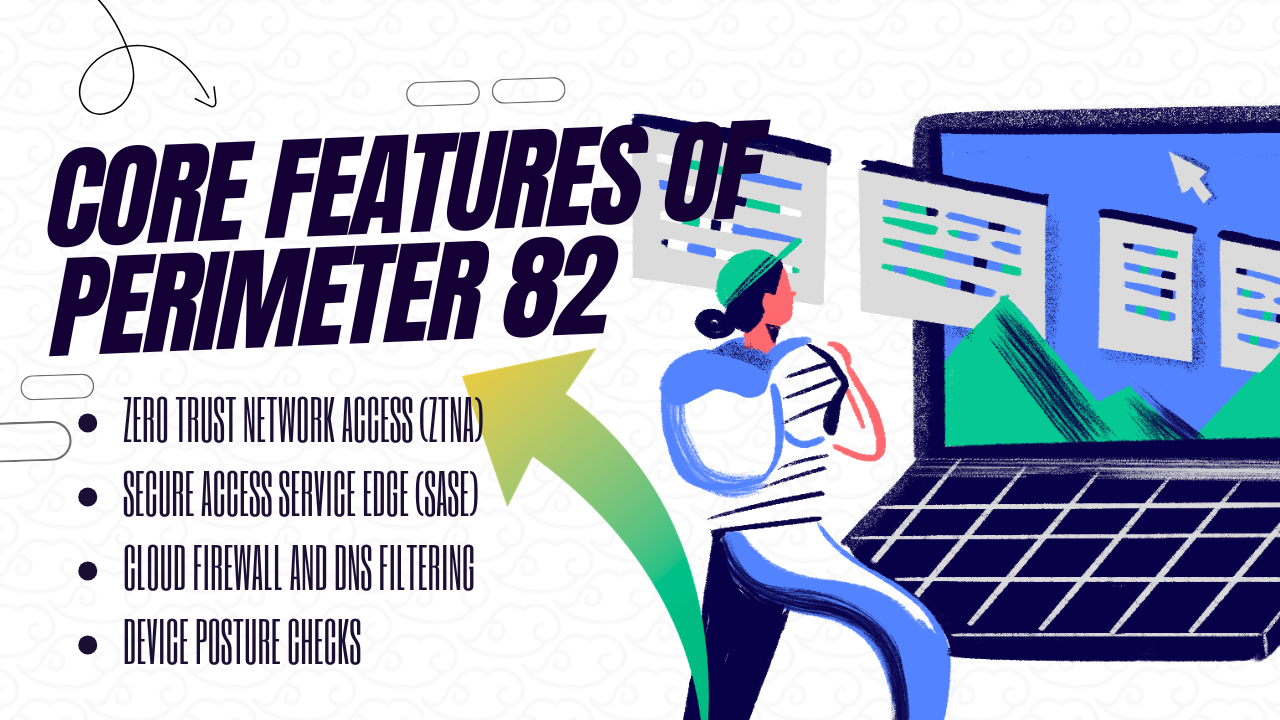
Perimeter 82 includes integrated cloud firewall capabilities that allow businesses to control and monitor network traffic through centralized policy management. Instead of manually configuring multiple hardware firewalls across different office locations, administrators can create security rules directly within the cloud dashboard.
DNS filtering is another standout feature that strengthens protection against malicious websites and phishing attacks. Before users can even connect to harmful domains, the system blocks suspicious requests automatically. This proactive filtering acts like a security guard stopping dangerous visitors at the entrance before they reach the building.
A company’s security is only as strong as the devices connected to its network. Perimeter 82 addresses this challenge through device posture checks, which evaluate endpoint security before granting access to business resources. The platform can verify whether devices have updated operating systems, active antivirus software, disk encryption, and other required security configurations.
This feature becomes increasingly important in environments where employees use personal laptops, smartphones, or tablets for work purposes. A compromised device can act like a Trojan horse, giving attackers access to sensitive systems. Device posture checks help prevent vulnerable endpoints from connecting until they meet predefined security standards.
One of Perimeter 82’s biggest strengths is its relatively simple deployment process compared to traditional enterprise security infrastructures. Legacy VPN systems often require physical appliances, complicated network engineering, and lengthy implementation timelines. Perimeter 82’s cloud-native architecture dramatically reduces this complexity.
Organizations can deploy secure remote access environments much faster because the platform integrates easily with major identity providers like Okta, Azure Active Directory, and Google Workspace. IT teams can onboard users, configure policies, and establish secure gateways without spending months building hardware-based infrastructure.
The administrative dashboard serves as the command center for the entire platform. IT teams can manage users, create access rules, monitor activity logs, and configure network segmentation policies from a single interface. This centralized visibility simplifies security management considerably compared to juggling multiple disconnected tools.
Granular administrative controls allow organizations to separate employees into different access groups based on departments, roles, or security requirements. For example, finance teams may only access accounting systems, while developers receive isolated access to coding environments. This segmentation strategy reduces exposure and improves overall security posture.
Strong encryption is one of the foundations of modern cybersecurity, and Perimeter 82 uses enterprise-grade encryption protocols to secure data transmissions between users and network gateways. This ensures sensitive information remains protected even when employees connect through unsecured public Wi-Fi networks.
Encryption acts like a sealed armored container for digital information. Even if attackers intercept traffic, they cannot easily read or manipulate the encrypted data.
Perimeter 82 also supports secure tunneling protocols designed to maintain confidentiality and integrity during remote connections. Combined with other security layers such as MFA and DNS filtering, encryption helps create a comprehensive defense strategy against eavesdropping and network interception attacks.
Identity security has become one of the most critical components of cybersecurity in 2026. Most breaches today involve compromised credentials rather than direct technical exploits. Perimeter 82 addresses this issue through integrated identity and access management features.
The platform supports Single Sign-On (SSO), Multi-Factor Authentication (MFA), and adaptive access controls. These tools strengthen authentication processes while improving user convenience. Instead of managing multiple passwords across different systems, employees can authenticate securely through centralized identity providers.
Adaptive access policies also add contextual intelligence to security decisions. For example, a login attempt from an unusual country or non-compliant device may trigger additional verification requirements. This layered authentication strategy makes it significantly harder for attackers to exploit stolen credentials successfully.
Threat prevention is another area where Perimeter 82 delivers strong capabilities. The platform provides visibility into user activity, network traffic, and suspicious behavior patterns through centralized monitoring tools. Administrators can review logs, investigate incidents, and identify unusual access attempts more efficiently.
DNS filtering and network segmentation help reduce attack surfaces proactively. By blocking malicious domains and isolating sensitive systems, the platform minimizes opportunities for ransomware and malware infections. Continuous monitoring also helps organizations detect anomalies before they escalate into full-scale security incidents.
Performance matters enormously for remote workforce productivity. Security tools that slow down internet connectivity or create unstable connections can frustrate employees and reduce operational efficiency. Perimeter 82 generally performs well due to its distributed cloud infrastructure and optimized gateway routing.
Instead of forcing all traffic through centralized office networks, the platform allows users to connect through nearby cloud gateways. This reduces latency and improves application responsiveness, especially for globally distributed teams. Employees can access cloud applications, internal systems, and collaboration tools more smoothly.
Remote and hybrid work environments have become permanent realities for many businesses in 2026. Perimeter 82 is specifically optimized for these modern workforce models. Employees can connect securely without manually configuring complex VPN settings or relying on office-based infrastructure.
The platform’s automated security features simplify remote access significantly. Employees working from home, coworking spaces, or public networks can maintain secure connectivity with minimal technical intervention. This seamless experience improves productivity while reducing support requests for IT departments.
Businesses also benefit from centralized visibility across distributed teams. Administrators can monitor user activity, enforce policies consistently, and maintain compliance regardless of employee location. This flexibility is one of the main reasons cloud-native Zero Trust platforms continue gaining popularity across industries.
Perimeter 82 is generally positioned as a premium enterprise security platform rather than a low-cost consumer VPN. At first glance, some businesses may perceive the pricing as expensive. However, comparing it directly to traditional VPN services overlooks the broader feature set and operational benefits provided by the platform.
Legacy infrastructures often involve substantial hardware investments, maintenance contracts, engineering costs, and ongoing upgrade expenses. Businesses may need separate solutions for VPN access, firewalls, DNS filtering, endpoint security, and monitoring systems. Managing these disconnected tools increases both operational complexity and long-term costs.
The return on investment for Perimeter 82 depends heavily on organizational size, security requirements, and operational complexity. Small businesses benefit from simplified deployment, centralized management, and reduced infrastructure maintenance. Large enterprises gain scalability, segmentation controls, and enhanced visibility across distributed environments.
Cybersecurity investments are often difficult to measure directly because their value lies in preventing catastrophic incidents. A single ransomware attack or credential compromise can result in millions of dollars in damages, downtime, legal expenses, and reputational harm. Strong Zero Trust protections help reduce these risks substantially.
Cloudflare Zero Trust is one of Perimeter 82’s major competitors in the SASE and Zero Trust market. Cloudflare benefits from an enormous global network infrastructure and strong performance optimization capabilities. Its platform is highly scalable and offers extensive networking features for enterprise environments.
Perimeter 82, however, is often praised for its ease of deployment and user-friendly management interface. Businesses with smaller IT teams may find it easier to implement and maintain compared to more technically demanding enterprise solutions.
Cato Networks is another major player in the SASE market, known for its robust global backbone infrastructure and enterprise-grade connectivity. Many large organizations consider Cato a premium solution for secure networking and remote access optimization.
Perimeter 82 competes by offering strong security features combined with flexible deployment and centralized management. Some businesses view it as a more accessible option for mid-sized organizations transitioning toward Zero Trust architectures.
Real-world user feedback for Perimeter 82 in 2026 is generally positive, especially among organizations modernizing their remote access security infrastructure. Many businesses praise the platform’s intuitive dashboard, centralized management, and strong support for hybrid work environments.
Users frequently mention that deployment is faster and less complicated than traditional VPN infrastructures. IT teams appreciate having firewall management, DNS filtering, and Zero Trust controls integrated into one cloud-based platform instead of managing multiple disconnected tools.
Still, some organizations report challenges during large-scale migrations or complex policy implementations. Advanced Zero Trust environments require careful planning and detailed access mapping, which can increase administrative complexity. Even so, most users agree that the platform delivers substantial security improvements compared to legacy networking approaches.
For organizations embracing cloud-first operations and remote work models, Perimeter 82 delivers significant value in 2026. The platform aligns closely with modern cybersecurity principles by emphasizing Zero Trust verification, least-privilege access, and cloud-native scalability.
Businesses handling sensitive data or operating in compliance-heavy industries may particularly benefit from its layered security approach. The combination of ZTNA, SASE, DNS filtering, posture checks, and centralized management creates a strong defensive framework against evolving cyber threats.
The platform may not be necessary for very small organizations with minimal networking requirements. However, for businesses seeking modern enterprise-grade security and operational flexibility, Perimeter 82 represents a compelling investment in long-term cybersecurity resilience.
Perimeter 82 has established itself as a strong contender in the rapidly growing Zero Trust and SASE security market. Its cloud-native architecture, centralized management capabilities, and granular access controls make it highly attractive for organizations transitioning away from traditional VPN infrastructures.
The platform excels in supporting remote and hybrid workforces while simplifying network security management through integrated tools and automation. Businesses gain stronger protection against credential theft, ransomware, phishing attacks, and unauthorized access attempts without relying on outdated perimeter-based defenses.
Perimeter 82 is primarily used for secure remote access, Zero Trust Network Access (ZTNA), cloud firewall management, DNS filtering, and SASE-based network security.
Yes, for most enterprise environments. Unlike traditional VPNs that provide broad network access, Perimeter 82 uses granular Zero Trust controls to reduce security risks.
Absolutely. The platform is specifically designed for remote and hybrid work environments with cloud-based connectivity and centralized management.
It can be suitable for small businesses needing advanced security capabilities, although very small organizations may find simpler VPN solutions more cost-effective.
Its major advantages include Zero Trust architecture, integrated SASE capabilities, centralized management, DNS filtering, device posture checks, and strong support for distributed workforces.

Related Posts
K&F Concept Review: Quality, Pricing & Performance
Insurance Finance Affiliate Marketing Branding Business Digital Marketing Market Trends Technology K&F Concept Review: Quality, Pricing & Performance If you’ve

Why Nihaojewelry Is Popular for Wholesale Jewelry
Insurance Finance Affiliate Marketing Branding Business Digital Marketing Market Trends Technology Why Nihaojewelry Is Popular for Wholesale Jewelry The wholesale

Perk Clothing Review: Style, Quality & Pricing
Insurance Finance Affiliate Marketing Branding Business Digital Marketing Market Trends Technology Perk Clothing Review: Style, Quality & Pricing Before diving

Woolx Review: Comfort, Quality & Pricing
Insurance Finance Affiliate Marketing Branding Business Digital Marketing Market Trends Technology Woolx Review: Comfort, Quality & Pricing Merino wool clothing

Ranowear, Inc. Review: Quality, Pricing & Style
Insurance Finance Affiliate Marketing Branding Business Digital Marketing Market Trends Technology Ranowear, Inc. Review: Quality, Pricing & Style This blog

Silicon3 Review: Features,Services & Pricing
Insurance Finance Affiliate Marketing Branding Business Digital Marketing Market Trends Technology Silicon3 Review: Features,Services & Pricing Discover a complete Silicon3

CapitalPlus delivers intelligent financial solutions powered by advanced research and innovation.